Saturday, 7 December 2019

Reddit links UK-US trade talk leak to Russian influence campaign

Reddit has linked account activity involving the leak and amplification of sensitive UK-US trade talks on its platform during the ongoing UK election campaign to a suspected Russian political influence operation.

Or, to put it more plainly, the social network suspects that Russian operatives are behind the leak of sensitive trade data — likely with the intention of impacting the UK’s General Election campaign.

The country goes to the polls next week, on December 12.

The UK has been politically deadlocked since mid 2016 over how to implement the result of the referendum to leave the European Union. The minority Conservative government has struggled to negotiate a brexit deal that parliament backs. Another hung parliament or minority government would likely result in continued uncertainty.

In a post discussing the “Suspected campaign from Russia”, Reddit writes:

We were recently made aware of a post on Reddit that included leaked documents from the UK. We investigated this account and the accounts connected to it, and today we believe this was part of a campaign that has been reported as originating from Russia.

Earlier this year Facebook discovered a Russian campaign on its platform, which was further analyzed by the Atlantic Council and dubbed “Secondary Infektion.” Suspect accounts on Reddit were recently reported to us, along with indicators from law enforcement, and we were able to confirm that they did indeed show a pattern of coordination. We were then able to use these accounts to identify additional suspect accounts that were part of the campaign on Reddit. This group provides us with important attribution for the recent posting of the leaked UK documents, as well as insights into how adversaries are adapting their tactics.

Reddit says that an account, called gregoratior, originally posted the leaked trade talks document. Later a second account, ostermaxnn, reposted it. The platform also found a “pocket of accounts” that worked together to manipulate votes on the original post in an attempt to amplify it. Though fairly fruitlessly, as it turned out; the leak gained little attention on Reddit, per the company.

As a result of the investigation Reddit says it has banned 1 subreddit and 61 accounts — under policies against vote manipulation and misuse of its platform.

The story doesn’t end there, though, because whoever was behind the trade talk leak appears to have resorted to additional tactics to draw attention to it — including emailing campaign groups and political activists directly.

This activity did bear fruit this month when the opposition Labour party got hold of the leak and made it into a major campaign issue, claiming the 451-page document shows the Conservative party, led by Boris Johnson, is plotting to sell off the country’s free-at-the-point-of-use National Health Service (NHS) to US private health insurance firms and drug companies.

Labour party leader, Jeremy Corbyn, showed a heavily redacted version of the document during a TV leaders debate earlier this month, later calling a press conference to reveal a fully un-redacted version of the data — arguing the document proves the NHS is in grave danger if the Conservatives are re-elected.

Johnson has denied Labour’s accusation that the NHS will be carved up as the price of a Trump trade deal. But the leaked document itself is genuine.

It details preliminary meetings between UK and US trade negotiators, which took place between July 2017 and July 2019, in which discussion of the NHS does take place, in addition to other issues such as food standards.

Although the document does not confirm what position the UK might seek to adopt in any future trade talks with the US.

The source of the heavily redacted version of the document appears to be a Freedom of Information (FOI) request by campaigning organisation, Global Justice Now — which told Vice it made an FOI request to the UK’s Department for International Trade around 18 months ago.

The group said it was subsequently emailed a fully unredacted version of the document by an unknown source which also appears to have sent the data directly to the Labour party. So while the influence operation looks to have originated on Reddit, the agents behind it seem to have resorted to more direct means of data dissemination in order for the leak to gain the required attention to become an election-influencing issue.

Experts in online influence operations had already suggested similarities between the trade talks leak and an earlier Russian operation, dubbed Secondary Infektion, which involved the leak of fake documents on multiple online platforms. Facebook identified and took down that operation in May.

In a report analysing the most recent leak, social network mapping and analysis firm Graphika says the key question is how the trade document came to be disseminated online a few weeks before the election.

“The mysterious [Reddit] user seemingly originated the leak of a diplomatic document by posting it around online, just six weeks before the UK elections. This raises the question of how the user got hold of the document in the first place,” it writes. “This is the single most pressing question that arises from this report.”

Graphika’s analysis concludes that the manner of leaking and amplifying the trade talks data “closely resembles” the known Russian information operation, Secondary Infektion.

“The similarities to Secondary Infektion are not enough to provide conclusive attribution but are too close to be simply a coincidence. They could indicate a return of the actors behind Secondary Infektion or a sophisticated attempt by unknown actors to mimic it,” it adds.

Internet-enabled Russian influence operations that feature hacking and strategically timed data dumps of confidential/sensitive information, as well as the seeding and amplification of political disinformation which is intended to polarize, confuse and/or disengage voters, have become a regular feature of Western elections in recent years.

The most high profile example of Russian election interference remains the 2016 hack of documents and emails from Hillary Clinton’s presidential campaign and Democratic National Committee — which went on to be confirmed by US investigators as an operation by Russia’s GRU intelligence agency.

In 2017 emails were also leaked from French president Emmanuel Macron’s campaign shortly before his election — although with apparently minimal impact in that case. (Attribution is also less clear-cut.)

Russian activity targeting UK elections and referendums remains a matter of intense interest and investigation — and had been raised publicly as a concern by former prime minister, Theresa May, in 2017.

Although her government failed to act on recommendations to strengthen UK election and data laws to respond to the risks posed by Internet-enabled interference. She also did nothing to investigate questions over the extent of foreign interference in the 2016 brexit referendum.

May was finally unseated by the ongoing political turmoil around brexit this summer, when Johnson took over as prime minister. But he has also turned a wilfully blind eye to the risks around foreign election interference — while fully availing himself of data-fuelled digital campaign methods whose ethics have been questioned by multiple UK oversight bodies.

A report into Russian interference in UK politics which was compiled by the UK’s intelligence and security parliamentary committee — and had been due to be published ahead of the general election — was also personally blocked from publication by the prime minister.

Voters won’t now get to see that information until after the election. Or, well, barring another strategic leak…


from TechCrunch https://ift.tt/388HcXA

Facebook sells off Oculus Medium to Adobe

Facebook is selling Oculus Medium — a 3D virtual reality sculpting tool for creatives — to Adobe. The team was an expensive effort for Oculus and its sale signifies a broader rethinking within Facebook in what virtual reality projects they tackle in-house.

It’s clear that Oculus pumped an awful lot of money into Medium over the years and the sale probably isn’t great for the Oculus Medium team, if only because there is now a proper price tag attached to the effort that will be looming for the fairly niche software. Terms of the deal weren’t shared so who knows what kind of deal Adobe got.

What is nice is that Facebook went to the trouble of properly spinning out Medium. When Facebook shut down Oculus Story Studio, the company quietly laid off its employees. Medium is well-liked by a small community and it makes plenty of sense at Adobe where first-party integration with other products will undoubtedly make it better software. It’s nice to see it live on.

The sale of Medium after the purchase of Beat Saber-maker Beat Games really encapsulates the VR content strategy of Oculus at the moment. Non-gaming creative tools aren’t getting new investment, cinematic VR content isn’t being prioritized, and Facebook is preparing to buy more game studios with the goal of scaling their titles. For a division that has been talking only about the distant future for years, it’s a pragmatic strategy that probably signifies broader contentment with how things are looking on the hardware front.


from TechCrunch https://ift.tt/2YpgxkZ

Friday, 6 December 2019

See Atomico’s most senior VCs on stage at Disrupt Berlin

Atomico is among the most widely respected venture firms in Europe, ranking right up there with friendly rivals like Accel London and Index Ventures.

It’s also just 13 years old at this point, compared with its more established peers. It’s easy to overlook this, considering the impact the firm has made on the European startup scene since Swedish billionaire Niklas Zennström — who’d previously cofounded Skype and Kazaa — first swung open its doors.

Consider that four funds and $1.5 billion dollars in asset under management later, Atomico is now among Europe’s largest early-stage funds. It also has one of the most enviable portfolios, with companies that include Klarna (valued at $5.5 billion), Graphcore (valued at $1 billion), Stripe (valued at $35 billion) and Compass (valued at $6.4 billion), as well as a growing long list of past winners, including Climate Corp., which sold to Monsanto for $1.1 billion back in 2013.

In fact,  it was through this last investment  that Atomico first met Siraj Khaliq, who is today among the most senior members of the Atomico team and who will be joining us on stage at TechCrunch Berlin next week for a wide-ranging discussion about where Atomico is shopping — and how the different geographies it covers are evolving.

Khaliq previously cofounded and served as CTO of The Climate Corp. and today leads Atomico’s “frontier” investment team. He’ll be talking with us along the firm’s other most senior members, including Niall Wass, who co-leads the firm’s consumer investment team; Sophia Bendz, who lead Atomico’s Nordic investment sourcing, as well as its angel program; and Hiro Tamura, who co-leads the firm’s consumer investment team with Wass and also leads its later-stage investing team. (Tamura is also the longest serving partner at Atomico after Zennström.)

What excites them, what concerns them, and how are they trying to prepare for 2020? We’re thrilled to be sitting down with them to talk about these questions and much more.

If you care about what’s happening on the ground in Europe, this is one conversation you won’t want to miss. Tickets to the show are still available. You can find the entire Disrupt Berlin agenda here.


from TechCrunch https://ift.tt/2YscOmt

The inevitable takedown of the female CEO

Four years ago when I founded Winnie, I set out to build a different kind of startup. Above and beyond any success our business achieved, it was most important to me that we create a culture where people would want to work. As a new mom at the time, I intentionally decided to build a company where employees would not work on nights or weekends, where there was flexibility for employees to manage their lives outside of the office, where motherhood would no longer be a penalty but a bonus and where underrepresented groups would be valued and promoted. If we failed because we did those things, so be it.

Four years later, I’m proud of the culture my co-founder Anne Halsall and I have built. As it turns out, treating employees well, valuing their families and personal time and diversifying our team are not only the right things to do, but also competitive advantages.

Even so, I worry that being a woman and taking on the role of co-founder and CEO places a target on my back.

Aggressive. Blunt. Furious. These are words that have been used to criticize the behavior of female CEOs of prominent companies like Thinx, Cleo, Rent the Runway and ThirdLove, to name a few. Away is the latest female-led company to come under fire, in an article in The Verge on Thursday.

First, let me be clear: A toxic work culture is never acceptable. Regardless of who started a company or what kind of stress the company is under, it’s never okay to mistreat employees. Some of the things that came to light in these pieces are particularly abhorrent: sexual harassment, lying about one’s credentials, creating an unsafe space for underrepresented groups, overworking employees. These are dynamics that need to be called out and eliminated at all companies, whether female or male-led. The Away example is no exception.

But as a female founder and CEO of a growing company, I have to ask: Why does it seem like so many of the toxic companies in the news are founded and led by women? The number of major public corporations led by female CEOs is less than 5%, and of the 134 U.S.-based unicorns, only 14 even have a woman with a co-founder title.

For such a small fraction of female-led companies, the amount of negative press female CEOs receive is glaringly disproportionate. I have a couple of ideas why.

First, while much of what is revealed in these reports is disgusting, what also comes through is the stereotype of women leaders as “bitches.” Articles often highlight when female CEOs curse, yell and show anger or bawdiness, because the shock value is higher than when male CEOs demonstrate these behaviors. We ask women leaders not only to be successful, but also to be ladylike and likable. I have lost count of the number of times I’ve been criticized for not being warm and friendly enough, or saying things that were too blunt.

Second, studies show that when it comes to ethical failures, women are “judged more harshly than men.” The ThirdLove article calls out that “at a by women, for women company” ThirdLove’s practice of discouraging salary negotiation was particularly disappointing. Cleo’s last-minute setup of a mother’s room using hanging curtains and a TaskRabbit was described by employees as one of the “more outrageous” behaviors of the founder. As a breastfeeding mom myself, I hate when mother’s rooms are inadequate, but male-led companies have poor lactation accommodations all the time.

The way we are targeting female founders and CEOs is doing nothing to encourage gender equality. It is only ensuring that the number of female CEOs is dwindling under the pressure of having to live up to stricter standards than men. So what can each of us do to create a more fair and accurate picture?

Reporters should continue to hold companies accountable, but just seek stories of male CEOs in equal proportion to the number of male-led companies out there. Those stories are there and only a few of the very worst examples have been exposed. Let’s have it take much less time to expose the next Travis Kalanick or Adam Neumann.

As readers, it is also worth being aware of our own biases. We can ask ourselves if we’re more outraged at a behavior because it comes from a woman, and if there are men we’re allowing to go unscrutinized. We can ask ourselves if maybe we enjoy seeing successful women taken down a notch (I certainly hope the answer is no).

I will continue to implement a healthy work environment at Winnie, grow a company where my employees can thrive and hold myself to the highest standards of conduct. But as we continue to take down the already few female CEOs one by one, I can only hope that what I do will be enough.


from TechCrunch https://ift.tt/2Prop1o

Qualcomm Windows on Snapdragon: New 7c & 8c SoCs for sub-$800 Laptops

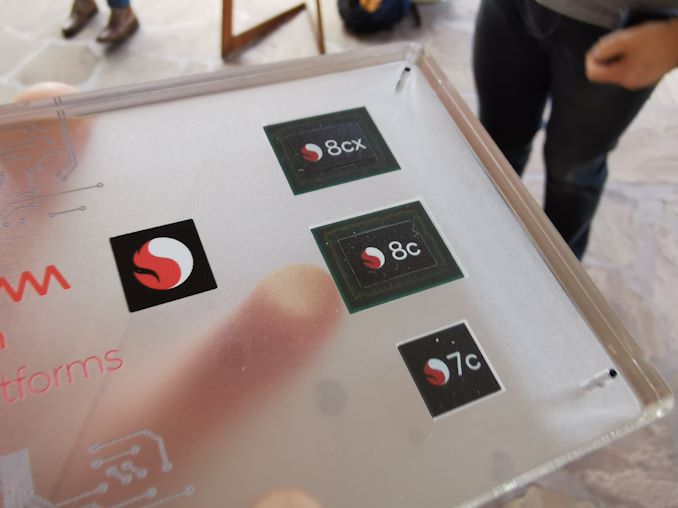
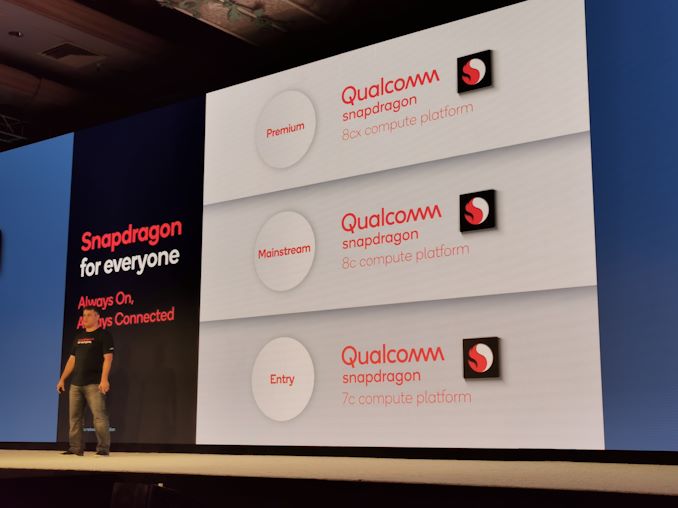
Last year Qualcomm introduced its flagship Snapdragon 8cx platform for premium always-connected PCs (ACPCs) that packed the best technologies that the company had to offer at the time. Being a no-compromise solution, the Snapdragon 8cx was not meant for every ACPC out there, so this week the company expanded the lineup of its SoCs for laptops with the Snapdragon 7c for entry-level machines and the Snapdragon 8c for mainstream always-connected notebooks.

Qualcomm aimed its Snapdragon 8cx primarily at flagship devices ACPCs and therefore maxed out its performance and capabilities, as well as offering the ability to add a 5G modem inside. To day the SoC has won only three designs: the Lenovo 5G laptop (which is yet to ship), the Microsoft Surface Pro X (which uses a semi-custom version called SQ1), and the Samsung Galaxy Book S — all of which are going to cost well over $1000.

In a bid to address more affordable machines, Qualcomm will roll-out its slightly cheaper Snapdragon 8c SoC that is the same silicon as the 8cx, but will feature a tad lower performance. The 7c by comparison is a new chip that will also have a smartphone counterpart, and is aimed at sub-$400 devices, according to analyst Patrick Moorehead. Qualcomm even stated that the 7c is going to target Chromebook equivalents, if not ChromeOS itself.

Qualcomm Snapdragon Flagship SoCs 2019-2020
SoC Snapdragon 8cx Snapdragon 8c Snapdragon 7c
CPU 4x Kryo 495 Gold
4x Kryo 495 Silver
Up to 2.84 GHz
4x Kryo 490 Gold
4x Kryo 490 Silver
Up to 2.45 GHz
8x Kryo 468
Up to 2.40 GHz
GPU Adreno 680 Adreno 675 Adreno 618
DSP / NPU Hexagon 690 Hexagon 690 Hexagon ?
AI Perf Combined 7 TOPs 6 TOPs 5 TOPs
Memory
Controller
8x 16-bit CH
LPDDR4X-4266
63.58 GB/s
4x 16-bit CH
LPDDR4X-4266
31.79 GB/s
2 x 16-bit CH
LPDDR4-4266
15.90 GB/s
ISP/Camera Dual 14-bit Spectra 390 ISP
1x 32MP or 2x 16MP
14-bit Spectra 255
1x 32MP or 2x 16MP
Decode
Encode
4K120 10-bit H.265
720p480
HDR Support
4Kp60
?
HDR Support
Wi-Fi Wi-Fi 5 Wi-Fi 6
Integrated Modem Snapdragon X24 LTE
(Category 20)

DL = 2000 Mbps
7x20MHz CA, 256-QAM, 4x4

UL = 316 Mbps
3x20MHz CA, 256-QAM
Snapdragon X15 LTE
(Category 15/13)

DL: 800 Mbps
3x20MHz CA, 256-QAM, 4x4

UL: 150 Mbps
2x20MHz CA, 64-QAM
External Modem Snapdragon X55

(LTE Category 24/22)
DL = 2500 Mbps
7x20MHz CA, 1024-QAM
UL = 316 Mbps
3x20MHz CA, 256-QAM

(5G NR Sub-6 + mmWave)
DL = 7000 Mbps
UL = 3000 Mbps

-
Mfc. Process TSMC
7nm (N7)
7nm Samsung
8nm

The 8c is the same chip as the 8cx, but clocked slightly lower. The 7c by contrast is built on Samsung’s 8nm process, and will mirror the specifications of a mid-range mobile chip in 2020. We were told that the 7c chip isn’t exactly ready yet, although other press were told that demos that were supposedly on 7c devices in our briefing were actually running 7c silicon.

The 8c, being an 8cx variant, can be paired with Qualcomm’s X55 modem to enable 5G connectivity, although it will be up to the OEM in order to determine if the device will have both Sub 6 GHz and mmWave support.

Devices featuring the 8c and 7c should come to market in 2020.

Alex Katouzian, senior vice president and general manager of mobile at Qualcomm Technologies, said the following:

“The mobile-first consumer wants an experience on par with a smartphone, and we have the innovation, the inventions and the technology to enable this experience for customers across price points.”

Related Reading

Source: Qualcomm


from AnandTech https://ift.tt/2OXnt5S
via gqrds