Friday, 31 May 2019

Touring Factory Berlin, Europe’s ‘largest club for startups’

According to the startups at Factory Berlin, it’s not just another coworking space. After all, the company took its name from Andy Warhol’s famous factory in New York City, and it describes itself as “Europe’s largest club for startups.”

Late last year, we toured Factory Berlin’s five-story, 14,000 square meter location in Görlitzer Park. Yes, it’s a building where startups can rent workspace, but as part of the tour, we had a chance to talk to several entrepreneurs, and everyone described it as a real community.

“Being part of the community, to us, means not isolating ourselves from the outer world,” said Code University founder Tom Bachem. “Or especially in Berlin, from the great startup ecosystem that we have — but instead, really deeply integrating into it.”

Similarly, Neel Popat of Donut pointed to the Factory’s blockchain events and showcases as a major benefit, while Kip Carter of New School said his team has used Factory messaging app to find experts who can work with New School’s kids.

And |Pipe| founder and CEO Simon Hossell said it’s been a great base for entrepreneurs who aren’t from Berlin: “It’s the fact that you know although you may be a stranger or a foreigner in a new city, there’s always a group of people — likeminded, smart, intelligent individuals around you that are always there to help and encourage.”


from TechCrunch https://tcrn.ch/2JQFHEO

NYC’s contactless subway turnstiles open today with Apple, Google, Samsung and Fitbit Pay support

After weeks of sporting “Coming Soon” screens, the New York City MTA’s OMNY pilot finally launched today. The system augments the city’s MetroCard swipes with new contactless screens that work with contactless prepaid credit and debit cards and a variety of different smart devices.

We’ve highlighted the latter already. For starters, the system will work with Apple, Google, Samsung and Fitbit Pay, which means it will be open to a large range of smartphones and wearables.

Contactless cards are those with NFC chips sporting a four-bar wave symbol that are already available from a number of big banks and credit card companies. Per the MTA’s site, the list of partners includes Chase, Visa, Mastercard and American Express, which should cover a majority of card holders, one way or another.

That’s a big no for Diners Club, Japan Credit Bureau and China UnionPay. Also, PIN-protected cards don’t currently work, nor do gift cards and non-reloadable cards. Another important restriction in all of this is the fact that the system is currently limited to single-ride. That means the large number of New Yorkers who currently use daily, weekly and monthly passes to save on the ever-increasing ride prices are SOL for now.

Ride plans will be coming before 2021. The MTA says it also plans to have the system implemented in all subway stations and buses before then. For now it’s currently limited to the 4, 5, 6 line between Grand Central Station in Manhattan and Brooklyn’s Atlantic Avenue-Barclays Center, as well as Staten Island buses.

Having demoed the system recently, I attest that it works well on both the iPhone and Apple Watch. It remains to be seen, however, how much of a logjam this technology will create in its first weeks and months. Ultimately, however, it should go a ways toward speeding things up as riders no longer have to fumble for their MetroCard and deal with aging swipe readers.


from TechCrunch https://tcrn.ch/2Wzb3W5

Security startup Bugcrowd on crowdsourcing bug bounties: ‘Cybersecurity is a people problem’

For a cybersecurity company, Bugcrowd relies much more on people than it does on technology.

For as long as humans are writing software, developers and programmers are going to make mistakes, said Casey Ellis, the company’s founder and chief technology officer in an interview TechCrunch from his San Francisco headquarters.

“Cybersecurity is fundamentally a people problem,” he said. “Humans are actually the root of the problem,” he said. And when humans made coding mistakes that turn into bugs or vulnerabilities that be exploited, that’s where Bugcrowd comes in — by trying to mitigate the fallout before they can be maliciously exploited.

Founded in 2011, Bugcrowd is one of the largest bug bounty and vulnerability disclosure companies on the internet today. The company relies on bug finders, hackers, and security researchers to find and privately report security flaws that could damage systems or putting user data at risk.

Bugcrowd acts as an intermediary by passing the bug to the companies to get fixed — potentially helping them to dodge a future security headache like a leak or a breach — in return for payout to the finder.

The greater the vulnerability, the higher the payout.

“The space we’re in is brokering conversations between different groups of people that don’t necessarily have a good history of getting along but desperately need to talk to each other,” said Ellis.


from TechCrunch https://tcrn.ch/2Khqax0

If you use women as decorative objects, then I will assume your tech is from the 1950s, too

Computex, which wrapped up today, is divided into two venues in Taipei. One, Nangang Exhibition Center, is where the big companies, including Asus and Microsoft, have their booths. The other, in Taipei World Trade Center, houses Innovex, the show’s exhibit for startups.

While walking around them, I realized that there are no “booth babes” at the Innovex location. The difference was striking. The show feels much more welcoming when you don’t have to elbow past crowds of men taking photos with models who have literally been branded with logos in the form of stickers, temporary tattoos or letters across the tops of their minidresses. There were less models at this year’s Computex compared to previous years, but during a walkthrough, I still counted 21 booths* in Nangang that had models standing in front of them.

Booth babes are a marketing gimmick that is particularly toxic and outdated in the post-#MeToo era, especially since several trade shows, including E3, Pax, Eurogamer, ChinaJoy and CES have either banned them outright, or at least instated guidelines to prevent things like the time Virgin Gaming had its models wear hot pants with QR codes on the buttocks.

Increasing awareness of sexual harassment and assault in the tech industry also makes the practice even more jarring than before—especially in Taiwan, which hasn’t had its #MeToo movement yet. The fact that many of the Nangang booths that used models were focused on gaming computers and peripherals was unsettling, because it suggested that those companies are either unaware of or simply do not care about the rampant, well-documented misogyny in the gaming community.

The sexism is also underscored by how little the models are required (or allowed) to do. Many of the women are represented by talent agencies that include performers, musicians and event emcees on their books. They can do more than hand out flyers or serve as walking billboards. But their talents are hidden at Computex. If you try to ask about a product, most direct you to one of the employees working at the booth. Booth babes are hired to serve solely as human decoration.

Most of the big tech companies that present at Computex don’t hire booth babes, but Asus was one exception. The company also scheduled several events, including its main press conference, in the evening, when many parents and other primary caretakers (who are likely to be women) are busy with their families. A lot of attendees are visitors from out of town, but for local employees tasked with working at those events, it likely meant rearranging their personal lives until the show was over. Overall, Computex did not paint a rosy picture of how Asus’ company culture views women and lent a sour note to otherwise interesting product releases. (At least this year Asus didn’t tweet a joke about one of its models’ rear ends, like it did in 2012).

An argument against the use of booth babes is the fact that booths at Innovex managed to draw large crowds of people without them, as long as they had a compelling product and presentation. It made the booths at Nangang that relied on models look backwards in comparison, the old vanguard of tech trying to hold onto relevancy with hired sex appeal.

*These booths were run by ATNG Power, Asus (and subsidiary Asustor), Apacer, Anaconda, V-Color Technology, Genesys Group, Blade-X, Mistel, Segotep, Abkoncore, Avita, Realan, Inno3D, TT Thermalake, Essencore, iGame, Biostar, Infineon, XPG and ASRock.


from TechCrunch https://tcrn.ch/2W1IA73

Spotify is building shared queue Social Listening

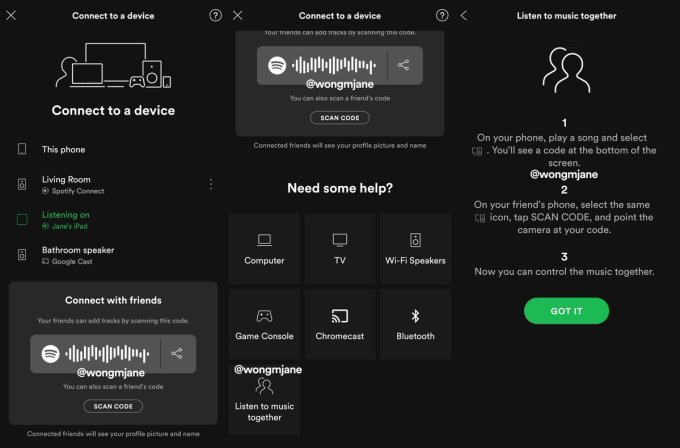
Want to rock out together even when you’re apart? Spotify has prototyped an unreleased feature called “Social Listening” that lets multiple people add songs to a queue they can all listen to. You just all scan one friend’s QR-style Spotify Social Listening code, and then anyone can add songs to the real-time playlist. Spotify could potentially expand the feature to synchronize playback so you’d actually hear the same notes at the same time, but for now it’s a just a shared queue.

Social Listening could give Spotify a new viral growth channel, as users could urge friends to download the app to sync up. The intimate experience of co-listening might lead to longer sessions with Spotify, boosting ad plays or subscription retention. Plus it could differentiate Spotify from Apple Music, YouTube Music, Tidal, and other competing streaming services.

A Spotify spokesperson tells TechCrunch that “We’re always testing new products and experiences, but have no further news to share at this time.” Spotify already offers Collaborative Playlists friends can add to, but Social Listening is designed for real-time sharing.

The feature is reminiscent of Turntable.fm, a 2011 startup that let people DJ in virtual rooms on their desktop that other people could join where they could chat, vote on the next song, and watch everyone’s avatars dance. But the company struggled to properly monetize through ad-free subscriptions and shut down in 2014. Facebook briefly offered its own version called “Listen With…” in 2012 that let Spotify or Rdio users synchronize music playback.

Spotify Social Listening was first spotted by reverse engineering sorceress and frequent TechCrunch tipster Jane Manchun Wong. She discovered code for the feature buried in Spotify’s Android app, but for now it’s only available to Spotify employees. Social Listening appears in the menu of connected devices you can open while playing a song beside nearby Wi-Fi and Bluetooth devices. “Connect with friends: Your friends can add tracks by scanning this code – You can also scan a friend’s code” the feature explains.

A help screen describes Social Listening as “Listen to music together. 1. On your phone, play a song and select (Connected Devices). You’ll see a code at the bottom of the screen. 2. On your friend’s phone, select the same (Connected Devices) icon, tap SCAN CODE, and point the camera at your code. 3. Now you can control the music together.” You’ll then see friends who are part of your Social Listening session listed in the Connected Devices menu. Users can also copy and share a link to join their Social Listening session that starts with the URL prefix https://spoti.fi/2HOWshq Note that Spotify never explicitly says that playback will be synchronized.

With streaming apps largely having the same music catalog and similar $9.99 per month premium pricing, they have to compete on discovery and user experience. Spotify has long been in the lead here with its algorithmically personalized Discover Weekly playlists that were promptly copied by Apple and SoundCloud.

Oddly, Spotify has stripped out some of its own social features over the years, eliminating the in-app messing inbox and instead pushing users to share songs over third-party messaging apps. The deemphasis in discovery through friends conveniently puts the focus on Spotify’s owned playlists. That gives it leverage over the record labels during their rate negotations since it’s who influences which songs will become hits, so if labels don’t play nice their artists might not get promoted via playlists.

That’s why it’s good to see Spotify remembering that music is an inherently social experience. Music physically touches us through its vibrations, and when people listen to the same songs and are literally moved by it at the same time, it creates a sense of togetherness we’re too often deprived of on the Internet.


from TechCrunch https://tcrn.ch/2W5QlJk