Tuesday, 30 April 2019

Services really are becoming a bigger part of Apple’s business


We’ve known for a while now that Apple was going to be putting more of an emphasis on services. As the technical leaps from one iPhone/iPad/Mac generation to the next become less dramatic, product revenue has started to shrink; in response, the company is focusing on driving forward on things like the App Store, iCloud, Apple Pay, Apple Music, and its soon-to-launch games and video offerings.

This shift is already playing out in the company’s financials. While product sales dipped a bit year-over-year — down from $51.3B in the quarter that ran from January to March 2018 to $46.6B in the same quarter of 2019 — revenue from the services business climbed from $9.9B to $11.5B.

In this fiscal Q2 quarter of 2018, Apple’s total revenue came in at roughly $61.1B; in the same quarter of 2019, it dipped to $58B. This works out to services accounting for 16.1% of Apple’s revenue in fiscal Q2 2018, but nearly 20% in fiscal Q2 2019. Apple CFO Luca Maestri says services now account for “one third” of the company’s gross profits.

A big part of Apple’s services business is monthly subscriptions — the things like iCloud, Apple Music, and Apple News that make money each month from the hardware they’ve already sold. Tim Cook says Apple now has 390 million paid subscriptions across its services. Cook didn’t dive into how that breaks down service-by-service, but that’s up roughly 30 million subscribers over last quarter. The company says it expects paid subscribers to surpass half a billion by 2020 (presumably fueled by the launch of its gaming/video services.)


from TechCrunch https://tcrn.ch/2DEwmLe

The curious case of Slack’s missing $162 million

Slack has filed its S-1 registration statement with the SEC in preparation for its direct listing. One interesting dataset that usually comes out of these S-1s is the company’s actual fundraising history. Slack has raised eight main rounds (series A-H), and 15 rounds total when including individual tranches since it incorporated on February 25, 2009 according to Delaware records.

Now that we have data, we can ask: how did the tech press do in covering the company?

Arman and I investigated by looking at coverage of Slack’s individual rounds of capital on startup news sites and comparing those reported numbers to the data now offered in the S-1. For the most part, the tech press did decently well, except for one curious, $162 million gap.

The missing Form D

First, though, a note about Form Ds.


from TechCrunch https://tcrn.ch/2JdTLaj

Spot.IM raises $25M to help publishers engage with readers

Spot.IM announced today that it has raised $25 million in Series D funding.

We’ve written about the company’s commenting platform before, but CEO Nadav Shoval said it’s now building a broader “community platform.”

That platform goes beyond commenting and moderation to also include community pages and other ways to highlight and monetize user generated content. Its customers include Hearst, Refinery29, Fox News and our corporate siblings at Engadget and AOL.com.

Shoval argued that these tools are particularly important as digital media businesses models are struggling — regardless of whether those publishers are focused on advertising, subscriptions or other business model, the key is to focus on loyal users rather than “random users that come in and disappear.

Spot.IM can make a big difference in this area by keeping users engaged, and by providing data to help publishers understanding the behavior and value of their users. In fact, Shoval said that for some publishers, a Spot.IM user will provide five times as much lifetime revenue as a non-Spot.IM user.

“We do believe it’s about better understanding: Who are our users, what do they want and how can we provide them with more value?” he added.

The company has now raised a total of $63 million, according to Crunchbase. The new funding was led by previous investor Insight Venture Partners with participation from Norma Investments (representing businessman Roman Abramovich), AltaIR Capital, Cerca and WGI Group (founded by Noah Goodhart, Jonah Goodhart and Mike Walrath).

Spot.IM is also announcing that it has appointed tech and media executive Itzik Ben-Bassat as president and as a member of its board of directors.


from TechCrunch https://tcrn.ch/2GSqD6C

Apple Q2: iPads up, iPhones down

Today’s big story for Apple revenue was once again focused on services. That’s likely to be the tale for the foreseeable future, as the company continues to pump billions into products offerings like Apple TV+.

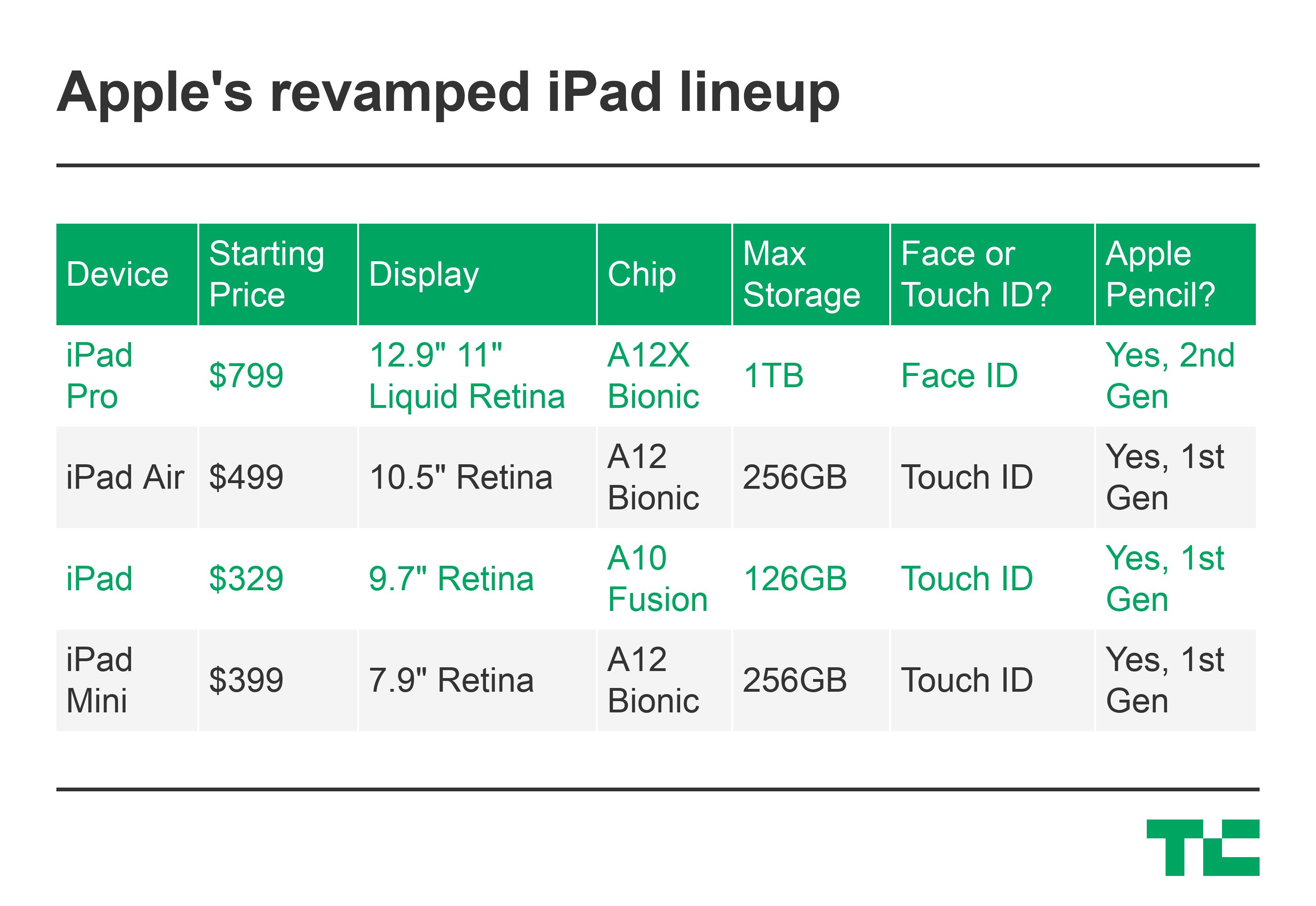
As predicted, hardware was more of a mixed bag for the company. The iPad, a bright spot in an otherwise stagnant tablet market also marked a key highlight the quarter, as revenue jumped 22 percent year over year. Notably, the company now offers its largest range of slates, with recent quiet refreshes to the Air and Mini following last year’s big Pro update.

Revenue for Mac dipped slightly, in spite of a recent refreshes to the MacBook Pro and iMac and last year’s milestone of 100 million Macs in use. iPhones missed expectations slightly, maintaining the recent downturn in handset sales.

Last quarter was a rough one for Apple devices, as iPhone revenue dropped 15 year over year. Tim Cook attempted to soften that blow with lowered guidance, pointing specifically to a less than spectacular showing in China. That, in turn, was the result of several factors, including a slowing Chinese economy and plateauing global smartphone numbers.

Yesterday’s Alphabet earnings took a similar line, as CEO Sundar Pichai noted “headwinds” in year on year sales of its Pixel device. Google is expected to follow in Apple’s footsteps with its own budget smartphone, the Pixel 3a next week at I/O.

Many analysts have pointed to 5G as the next major factor in kickstarting phone sales for both Apple and the rest of the industry. However, all signs currently point to a 2020 arrival for a 5G iPhone — putting the device more than a year out, and well behind releases from chief competition like Samsung and Huawei.

That said, a recent deal with Qualcomm finally ended the long time feud between the two hardware powerhouses could hasten the arrival of the technology on the iPhone. Though it seems equally likely the company will focus on other features and simply wait until next year, when 5G has had an opportunity for a much wider roll out.

In a statement, Cook lauded iPads sales, while attempting to set the stage for future announcements. “Our March quarter results show the continued strength of our installed base of over 1.4 billion active devices, as we set an all-time record for Services, and the strong momentum of our Wearables, Home and Accessories category, which set a new March quarter record,” Cook said. “We delivered our strongest iPad growth in six years, and we are as excited as ever about our pipeline of innovative hardware, software and services. We’re looking forward to sharing more with developers and customers at Apple’s 30th annual Worldwide Developers Conference in June.”

Last year’s WWDC was notably devoid of any sort of hardware announcements, with most coming toward the end of the year. This year’s could be different, as the company looks to shake loose some of the hardware cobwebs.


from TechCrunch https://tcrn.ch/2WeKbax

Apple’s stock jumps 5 percent after beating expectations

Apple released earnings for its fiscal second quarter today, reporting revenue of $58 billion, a decline of 5 percent from the year-ago quarter, and quarterly earnings per diluted share of $2.46, down 10 percent. International sales accounted for 61 percent of the quarter’s revenue.

The market apparently approves. Apple’s shares have jumped $10 apiece since the earnings were released, putting the company in spitting distance of the $1 trillion market cap it has been flirting with since last August.

The earnings are also in line with the guidance that Apple had provided during its last earnings call. In late January, per Apple’s guidance for the second quarter, it had estimated that its revenue would fall between $55 billion and $59 billion, its gross margins between 37 and 38 percent; its operating expenses between $8.5 billion and $8.6 billion; and that it would see other income of $300 million.

In a release, the company did not break out iPhone sales, which have come under pressure. Instead, CEO Tim Cook tries focusing attention on other aspects of the company’s business. “Our March quarter results show the continued strength of our installed base of over 1.4 billion active devices, as we set an all-time record for services, and the strong momentum of our wearables, home and accessories category, which set a new March quarter record,” said Cook in the release. “We delivered our strongest iPad growth in six years, and we are as excited as ever about our pipeline of innovative hardware, software and services. We’re looking forward to sharing more with developers and customers at Apple’s 30th annual Worldwide Developers Conference in June.”

Apple had a tough 2018, iPhone sales in the last quarter of the year falling 15 percent from where they’d been at the end of 2917 owing in part to stalled demand in China. Overall, sales in China fell a whopping 27 percent between the end of 2017 and the end of 2018, from $18 billion in revenue in the fourth quarter of 2017, or 20 percent of the company’s total revenue during the period, to $13.2 billion, or 16 percent of the total.

Apple has blamed softening consumer demand in China’s market for its woes, but it hasn’t given up on the country; it can’t afford to given its potential. In fact, earlier this month, to goose demand, Apple trimmed prices on the iPhone, iPad, and other products it sells in China by up to 6 percent, according to Xinhua, the state-run news agency. The move was ostensibly triggered by China reducing its value-added tax, which is akin to sales tax in the U.S., to 13 percent from 16 percent.

Devices have been tough for everyone. As we reported yesterday, Alphabet’s Q1 earnings were a disappointment for Wall Street primarily because of the company’s ad revenue shortcomings but also because of a stagnating global smartphone market that has impacted virtually all players. (CEO Sundar Pichai cited “year over year headwinds” when referring to the company’s smartphone line.)

In the meantime, Apple has dramatically increased its focus on its services business. Roughly a month ago, the company announced a credit card in partnership with Goldman Sachs and Mastercard that’s designed for the iPhone and works with the Wallet app. It also officially unveiled it streaming initiative, Apple TV+, which is coming this fall and will be supported through an ad-free subscription.

Apple announced last year that its fiscal fourth quarter of 2018 was the last quarter in which it would report detailed iPhone figures, which may well frustrate shareholders, as well as potential shareholders. As famed VC Bill Gurley noted in a series of tweets earlier today, “Interesting to see very large companies get away with a lack of segment disclosure. AWS for a long time was not broken out. Mixing search and YouTube revenues makes no sense for $GOOG, and is quite unhelpful to investors trying to understand the company . . .Our much smaller companies are routinely told by their auditors and the SEC that they need to provide segment analysis, but it seems remarkably unfair when a company the size of Google with a segment as large as YouTube (~$20B) are not held to same standard.”

We’ll have more on Apple’s earnings for you soon.


from TechCrunch https://tcrn.ch/2UVqXWg