Thursday, 28 February 2019

The $35,000 Tesla Model 3 has arrived — but there’s a cost

The long-awaited $35,000 Tesla Model 3 has finally arrived, three years after CEO Elon Musk promised to bring the electric vehicle to market at that price point. But that cheaper Model 3 comes with a price — or at least a dramatic shift for Tesla.

Tesla said that to achieve this lower price it will shift all sales globally to online only, meaning the company will be closing many of its stores over the next few months.

A small number of stores in high-traffic locations will remain as galleries, showcases and Tesla information centers, the company said.

“Shifting all sales online, combined with other ongoing cost efficiencies, will enable us to lower all vehicle prices by about 6% on average, allowing us to achieve the $35,000 Model 3 price point earlier than we expected,” the company wrote in a post.

Tesla announced Thursday that the $35,000 version will have a 220 miles of range and be able to reach a top speed of 130 miles per hour. 

The company also said it’s introducing a Model 3 Standard Range Plus version, which offers 240 miles of range, a top speed of 140 mph, and 0-60mph acceleration of 5.3 seconds as well as most premium interior features at $37,000 before incentives.

This is a developing story.

Just hours before the announcement, the “order” webpages for the Model 3, Model S and Model X vehicle redirected to show message that read “The wait is almost over.” Below the main message, it read “Great things are launching at 2 pm.”

Tesla CEO Elon Musk tweeted Feb. 27 “Some Tesla news,” followed by equally vague tweets “2 pm” and “California.”

The tweets had led to widespread speculation of what Musk would announce. Others argued that the teasing tweets were merely a tactic to distract investors and the media from his recent scuffle with the U.S. Securities and Exchange Commission.

The SEC asked a judge Feb. 25 to hold Musk in contempt for violating the settlement agreement reached with the agency last year. The SEC argued that a tweet sent by Musk on February 19 violated their agreement. Musk is supposed to get approval from Tesla’s board before communicating potentially material information to investors.

A U.S. judge issued an order Feb. 26 that gives Musk until March 11 to explain why he should not be held in contempt for violating a settlement agreement with the SEC.

This is a developing story.


from TechCrunch https://ift.tt/2NBxByS

Skyrim mod drama gets ugly with allegations of stolen code and misappropriated donations

The people who volunteer their time modifying and updating old games are among the most generous of developers. So when drama erupts there’s not just irritation and testy emails but a sense of a community being betrayed or taken advantage of. A recent conflict over work on the perennially renewed classic Skyrim may seem small but for those involved, it’s a huge upset.

I don’t mean to make a bigger deal out of this niche issue than it is; I feel though that sometimes it’s important to elevate things not because they are highly important in and of themselves, but because they represent a class of small injustices or conflicts that are rife on the modern web.

The example today comes from the Skyrim modding community, which creates all kinds of improvements for the classic fantasy adventure, from new items and better maps to complete overhauls. It’s one of the most active out there, as Bethesda not only is highly tolerant of modders but tends to ship games, if we’re honest, in pretty poor shape. Modders have taken to filling in the gaps left by Bethesda and making the original game far better than how it shipped.

One of the more useful of these mods, for developers but indirectly for players, is the Skyrim Script Extender, or SKSE. It basically allows for more complex behaviors for objects, locations, and NPCs. How do you have a character seek shelter from the rain if there’s no weather-based behaviors in their original AI? That sort of thing (though that’s an invented example). SKSE goes back a long way and the creators provide much of the code for others to use under a free license, while declining donations themselves.

Another project is Skyrim Together (ST), a small team which since 2013 has (among others) been working on adding multiplayer functionality to the game — their Patreon account, in contrast, is pulling in more than $30,000 a month. The main dev there allegedly independently distributed a modified version of SKSE several years ago against the terms of the license, and was henceforth specifically banned from using SKSE code in the future.

Guess what SKSE’s lead found in a bit of code inspection the other day?
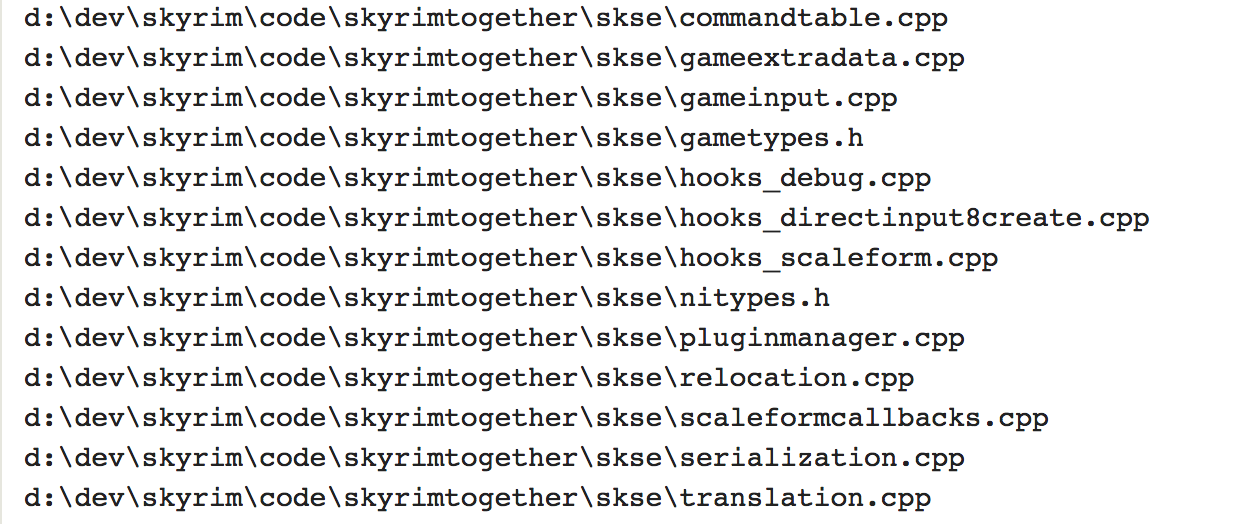
Yes, unfortunately, it seems that SKSE code is in the ST app, not only in violation of the license as far as not giving credit, but in that the dev himself has been barred from using it, and furthermore that — although there is some debate here — the ST team is essentially charging for access to a “closed beta.” Some say that it’s just a donation they ask for, but requiring a donation is really indistinguishable from charging for something.

A response from the devs downplayed the issue; they say it’s just a bit of old junk in the codebase:

There might be some leftover code from them in there that was overlooked when we removed it, it isn’t as simple as just deleting a folder, mainly our fault because we rushed some parts of the code. Anyway we are going to make sure to remove what might have slipped through the cracks for the next patch.

Instead of SKSE, one developer said, they had substituted other code, for instance from the project libSkyrim. But as others quickly pointed out, libSkyrim is based on SKSE and there’s no way they could be ignorant of that fact. So the assertion that they weren’t using the forbidden code doesn’t really hold water. Not only that, but ST doesn’t even credit libSkyrim at all, a standard practice when you reuse code.

This wouldn’t really be as big of a problem if ST was not only making quite a bit of scratch off their project via donations, but required donations for access to the code. That arguably makes it a commercial project, putting it even farther outside the bounds of code reuse.

Now, taking the hard work of open and semi-open source developers and using it in other projects is encouraged — in fact, it’s kind of the point. But it’s meant to be a collaboration, and the rules are there to make sure credit goes where it’s due.

I don’t think the ST people are villains; they’re working on something many players are interesting in using — and paying for, if the Patreon is any indication. That’s great, and it’s what the mod community is all about. But the other side of the community, as in any group of developers, is respectful and mutual acknowledgement.

Honesty is important here because it’s not always possible to audit someone else’s code. And honesty is also important because users want to be able to trust developers for a variety of reasons — not least of which that they are donating to a project working in good faith. That trust was shaken here.

As I said at the beginning, I don’t mean to make this a huge deal. No one is getting rich (though even split ten ways, $33,000 a month is nothing to sniff at), and no one is getting hurt. But I imagine there’s hardly an open source project out there that hasn’t had to police others’ use of their code or live in fear of someone cashing in on something they’ve donated their time to for years.

Here’s hoping this particular tempest in a teapot resolves happily, but don’t forget there’s a lot more teapots where this one came from.


from TechCrunch https://ift.tt/2EF5Xhq

It’s a new era for fertility tech

Women’s health has long been devoid of technological innovation, but when it comes to fertility options, that’s starting to change. Startups in the space are securing hundreds of millions in venture capital investment, a significant increase to the dearth of funding collected in previous years.

Fertility entrepreneurs are focused on a growing market: couples are choosing to reproduce later in life, an increasing number of female breadwinners are able to make their own decisions about when and how to reproduce, and overall, around 10% of women in the US today have trouble conceiving, according to the Centers for Disease Control and Prevention.

Startups, as a result, are working to improve various pain points in a women’s fertility journey, whether that be with new-age brick-and-mortar clinics, information platforms, mobile applications, wearables, direct-to-consumer medical tests or otherwise.

Although the investment numbers are still relatively small (compared to, say, scooters), the trend is up — here’s the latest from founders and investors in the space.

VCs want to help you get pregnant

Clue, a period and ovulation-tracking app, co-founder and CEO Ida Tin talks at TechCrunch Disrupt Berlin 2017 (Photo by Noam Galai/Getty Images for TechCrunch)

This fall, TechCrunch received a tip that SoftBank, a prolific venture capital firm known for its nearly $100 billion Vision Fund, was investing in Glow, a period-tracking app meant to help women get pregnant. Max Levchin, Glow’s co-founder and a well-known member of the PayPal mafia, succinctly responded to a TechCrunch inquiry regarding the deal via e-mail: “Fairly sure you got this particular story wrong,” he wrote. Glow co-founder and chief executive officer Mike Huang did not respond to multiple requests for comment at the time.

Needless to say, some semblance of a SoftBank fertility deal got this reporter interested in a space that seldom populates tech blogs.

Femtech, a term coined by Ida Tin, the founder of another period and ovulation-tracking app Clue, is defined as any software, diagnostics, products and services that leverage technology to improve women’s health. Femtech, and more specifically the businesses in the fertility and contraception lanes, hasn’t made headlines as often as AI or blockchain technology has, for example. Probably because companies in the sector haven’t closed as many notable venture deals. That’s changing.

The global fertility services market is expected to exceed $21 billion by 2020, according to Technavio. Meanwhile, private investment in the femtech space surpassed $400 million in 2018 after reaching a high of $354 million the previous year, per data collected from PitchBook and Crunchbase. This year already several companies have inked venture deals, including men’s fertility business Dadi and Extend Fertility, which helps women freeze their eggs.

“In the last three to six months, it feels like investor interest has gone through the roof,” Jake Anderson-Bialis, co-founder of FertilityIQ and a former investor at Sequoia Capital, told TechCrunch. “It’s three to four emails a day; people are coming out of the woodwork. It feels like somebody shook the snow globe here and it just hasn’t stopped for months now.”

Dadi, Extend Fertility and FertilityIQ are among a growing list of startups in the fertility space to crop up in recent years. FertilityIQ, for its part, provides a digital platform for fertility patients to research and review doctors and clinics. The company also collects data and issues reports, like this one, which ranked businesses by fertility benefits. Anderson-Bialis launched the platform with his wife, co-founder Deborah Anderson-Bialis, in 2016 after the pair overcame their own set of infertility issues.

Anderson-Bialis said he has recently fielded requests from seed, Series A and growth-stage investors interested in exploring the growing fertility market. His company, however, has yet to raise any outside capital. Why? He doesn’t see FertilityIQ as a venture-scale business, but rather a passion project, and he’s skeptical of the true market opportunity for other businesses in the space.


from TechCrunch https://ift.tt/2UkI0RK

This robot automatically sorts and prices cards from Magic: The Gathering

If you’ve ever dabbled in collectible card games — Magic: The Gathering, Pokémon, etc. — you know how quickly collections can grow. One pack turns into two. Two turns into five. Then they release some new set and… screw it, why not buy a whole box?

Card resellers have the same problem, just magnified to an extreme. People who’ve stopped playing a game for whatever reason (sometimes years prior) walk in with massive collections and just want to get rid of them. Online resellers and card stores can end up with monstrous stockpiles of unsorted cards, and going through them requires a ton of time and a wealth of ultra specific knowledge of a game. Which cards are rare? Which ones are a bit more common, but useful enough that players would want to buy them for their decks? What are they all worth?

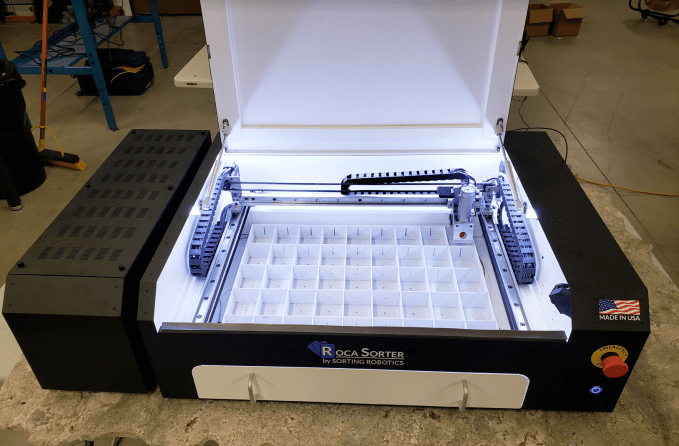
Sorting Robotics, a company in Y-Combinator’s Winter 2019 class, has built a robot laser-focused on that problem. You load it with up to 1000 Magic cards, and it’ll automatically sort them to your liking, look up their values, and give you all the data in a big spreadsheet.

The machine is able to sort by a bunch of different criteria, be it alphabetically, by the set a card is from, or by its resale value (as pulled from TCGPlayer.) Want a big pile of all of the cards worth over $1? It can do that. If you need them sorted other ways, the company is open to helping with custom sorting logic.

One challenge the team had to tackle early on was how to handle cards with minimal contact for the sake of preventing possible damage. Some Magic cards, after all, resell for hundreds or thousands of dollars — if their machines got a reputation for damaging cards even occasionally, no one would use it.

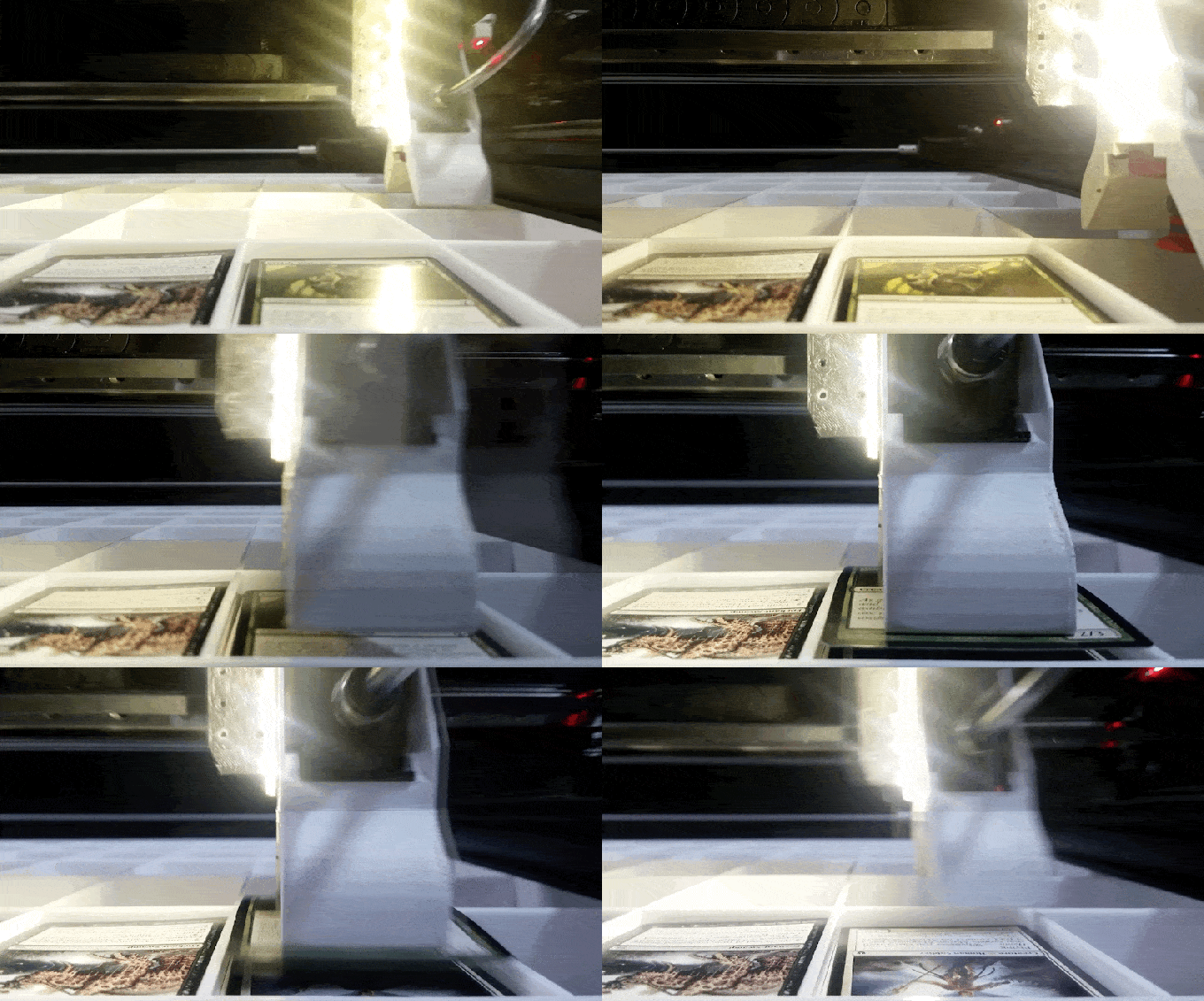
So Sorting came up with a pneumatic system that uses cameras, computer vision, polished surfaces, and silicone suction cups to identify and move cards from stack to stack with limited contact. There are a few fancy tricks involved, like picking up cards in a way that utilizes the airflow within the machine to keep it from lifting two lightly-stuck-together cards at once. If a card is loaded into the machine upside down, it’ll shift it into a pile with other upside down cards to be manually flipped and re-sorted later. Sorting 1000 cards takes 1-2 hours, depending on the criteria they’re being sorted by.

If a card does somehow get damaged, Sorting Robotics says they’ll cover the cost. (They’ll want to check the feed from a pair of cameras inside the machine to see exactly what happened, so you probably shouldn’t go throwing an already-bent up Time Walk card in there and asking for reimbursement.)

Another challenge: dirt. Even for collectors, cards are rarely 100% pristine. There’s the natural oils from your hand, the dust from being stored over time, and even some amount of the card’s own dust, left over from the printing and cutting process. You might not really notice it if you’re just dealing with your own collection — but when you’re putting thousands of cards through a machine with moving parts and camera lenses, the dust adds up fast. Later versions of their machine have been re-tailored to deal with dust, and to be more easily maintained when the dust builds up.

Sorting has three founders: Nohtal Partansky and Sean Lawler (both of whom were previously Systems Engineers at NASA’s Jet Propulsion lab), and Cassio Elias dos Santos Junior, a computer vision engineer who previously built a popular Magic card scanning app for Android.

As for how much it costs, the company would only say that it’s working on that on a case-by-case, shop-by-shop basis. They stressed that they’re focusing on building these for online resellers and card shops — so it sounds like it’s not in the price range that most hobbyists might consider.

The machine currently only sorts Magic cards, though the founders tell me support for Yu-Gi-Oh and Pokémon cards is coming shortly.


from TechCrunch https://ift.tt/2EkF7tB

Tesla halts online sales ahead of Elon Musk announcement

Tesla buyers might have a hard time ordering a vehicle through its website for the next several hours.

The “order” webpages for the Model 3, Model S and Model X vehicle all redirect to show nebulous  message that reads “”The wait is almost over.” Below the main message, it reads “Great things are launching at 2 pm.”

Tesla CEO Elon Musk tweeted Feb. 27 “Some Tesla news,” followed by equally vague tweets “2 pm” and “California.”

The tweets had lead to widespread speculation of what Musk will announce Thursday. It was enough to send shares higher yesterday.

This is a developing story.


from TechCrunch https://ift.tt/2UfFi00