Wednesday, 1 May 2019

BlackBuck raises $150 million to digitize freight and logistics across India

India’s trucking system has a big inefficiency problem that continues to drag the economy. BlackBuck, one of the handful logistics startups that is trying to overhaul this system, just raised $150 million in Series D round to further pursue its mission.

The new round was led by Goldman Sachs Investment Partners and Accel at a valuation just shy of $1 billion, according to a person familiar with the matter. Wellington, Sequoia Capital, B Capital, LightStreet, and existing investors Sands Capital and World Bank’s investment arm International Finance Corporation also participated in the round.

The four-year-old B2B startup, which connects businesses with truck owners and freight operators, has raised about $230 million in equity financing and another $100 million in debt financing to date, CEO Rajesh Yabaji told TechCrunch in an interview.

Yabaji said the startup will use the fresh capital to expand and improve its technology stack that enables truck drivers to find more work, and grow its fleet of driver partners. As of today, BlackBuck has 300,000 trucks on its platform and about 10,000 clients including big names such as soft drinks manufacturer Coca Cola, consumer goods giant Unilever, and automotive conglomerate Tata.

BlackBuck has developed a simplified app for truck drivers in India, who are typically not very literate, to help them easily navigate to the destination using Google Maps and accept work. On the client side, businesses can fire up a similar app to place orders. Recently it also tied up with insurance company Acko to cover all the trucks on its network.

So as things work at the moment, truck drivers in India often struggle to find any work on their way back from a drop. Yabaji says BlackBuck enables them to find 25% to 30% more work opportunities. The startup takes between 15% to 20% cut of that and this is how it makes money.

India’s logistics market, valued at $160 billion, has attracted major VC funds in recent years. Delhivery, a supply chain startup, has raised north of $670 million from SoftBank, and Tiger Global among others. Rivigo, a startup that rotates drivers to improve efficiency, has raised north of $215 million from SAIF Partners and Warburg Pincus.

It’s a capital-heavy business. BlackBuck, which employs about 2,000 people, generated $135.5 million in revenue at a loss of $17 million in fiscal year 2018, according to regulatory filings. Yabaji says the startup aims to aggressively grow its business, so profitability is not something it is hoping to go after in the immediate future.

“Given the market we are in today, in terms of private capital being available, we do not have to do IPO for a really long time. It is all about optimizing for the objective,” he said.

BlackBuck said it will also give about 200 of its employees an option to liquidate up to 25% of their vested shareholding in the company at the current price.


from TechCrunch https://tcrn.ch/2GKMr2S

Airbnb-backed OYO moves into Europe, acquires @Leisure from Axel Springer for $415M

OYO, the fast-growing budget hotel startup out of India that’s backed by Airbnb, SoftBank, Grab and Didi, has made an acquisition to expand its footprint into Europe, specifically around self-catering home rentals. The company has picked up @Leisure Group from Axel Springer for about $415 million (€369.5 million).

@Leisure sees traffic and business from some 2.8 million travellers annually from across 118 countries. Its European footprint covers some 115,000 homes, and some 300,000 rooms globally

It operates through various sub-brands, including Belvilla, DanCenter, Danland and Traum-Ferienwohnungen, and last year it posted Ebitda of more than €24 million, Axel Springer said.

The German media company, which acquired @Leisure four years ago for an undisclosed sum, also said the divestment is expected to close in June 2019, and will see it focusing more on its jobs and classifieds business as a result.

The deal is the latest big move for OYO, which is now valued at $5 billion, as it continues to expand its footprint outside of its home market, after launches in Japan in recent weeks and China last year.

While companies like Airbnb have expanded into higher end homes and business services, what its investment OYO brings is diversification into another segment of the market. OYO has built its business primarily on budget offerings — and with this deal into middle-class, family travel that’s often also planned on a budget.

That’s a strategy that has appeared to pay off in spades. OYO says it is now the world’s sixth-largest chain of hotels, a place it hopes to advance on the back of raising more than $1 billion in funding since September last year, first in a tranche of $1 billion that included SoftBank’s Vision Fund, and later through a strategic investment from Airbnb, which sources tell us was between $150 million and $200 million.

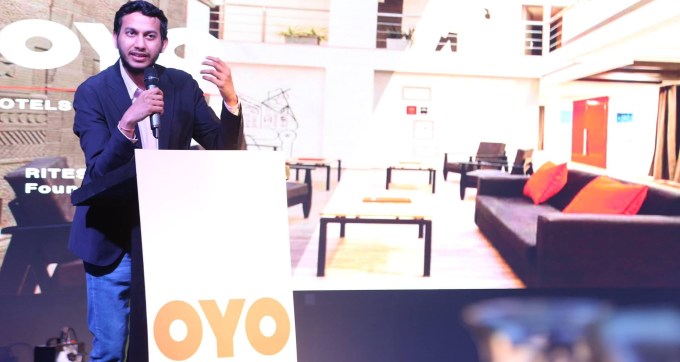
OYO founder and CEO Ritesh Agrawal

“We see vacation homes as a unique opportunity with 115,000 units of homes now getting added to our already growing count of beautiful homes and we are excited to continue maintaining our global industry leadership,” OYO’s founder and CEO Ritesh Agarwal (pictured above) said in a statement. “Our focus, however, will remain to be a beloved consumer brand that has the ability to create a perfect space in every place. The @Leisure Group is a great partner and we are excited to broad base their offerings. @Leisure Group has proven capabilities in helping develop Europe into a vacation rentals hotspot and we are keen to leverage their competencies towards ensuring beautiful vacation rental and urban homes experience for millions of tourists from every part of the world.”

Tobias Wann, the CEO @Leisure, is becoming CEO of Vacation Homes at OYO as part of the acquisition.

“We are delighted to join forces with OYO in its mission of creating quality and beautiful spaces,” he said in a statement. “@Leisure Group was started with a similar mission to identify and service all forms of vacation & urban home rentals, focusing on delivering a hassle-free experience to both homeowners and guests. I am delighted to share that we’ve successfully achieved that over the past few years, and now aspire to leverage our synergies to deepen our presence in Europe and look to expand globally.”

Europe’s vacation rental market will be worth some $18.6 billion this year, according to estimates, growing at between four and eight percent annually. Now that we are heading into the travel season we are seeing a number of deals emerging to capitalise on the opportunity both within the borders of the region, as well as to tap interest from international tourists coming to Europe. Earlier this week, we confirmed that GetYourGuide, a startup from Berlin that offers listings for tours and other travel experiences, is raising between €300 million and €500 million in funding at a valuation of about $1.6 billion.

Europe has also been an important type of market, in that it’s been one of the big leaders in self-catering vacation home rentals, so for OYO to break into Europe, having a network like this, ready-made rather than built from scratch, is one way to make the move quickly — a sentiment echoed by OYO itself:

“With Europe spearheading the vacation and urban home rental trend globally, @Leisure Group is uniquely positioned to capitalize on its experience and insights aided with OYO’s full stack approach towards building the world’s largest global vacation rentals business,” said OYO chief strategy officer Maninder Gulati in a statement. “If one were to look at Europe alone, there is an ever-increasing demand for vacation homes with an increasing trend of booking an entire home. Further, in such a market of largely fragmented small and independent players, and a handful of established players, of which @Leisure Group, is one of the largest, we feel travelers will be excited with what @Leisure Group can offer. Through this acquisition, the size and scale of the opportunity can be immediately unlocked for OYO’s Homes business.”

The deal will give OYO a big boost from its existing footprint, which had covered 800 cities in 24 countries, including the UK, US, India, China, Malaysia, Nepal, UAE, Indonesia, Saudi Arabia, the Philippines and Japan. It already had 18,000 buildings and 636,000 units under management, along with  40,000-holiday homes. Other investors in it include Sequoia Capital, Lightspeed Ventures, Hero Enterprise, and China Lodging Group. 


from TechCrunch https://tcrn.ch/2V5JYtP

Struggling grocery startup Honestbee fires its CEO

The changes continue to roll at Honestbee. Fresh from pausing operations in four countries and announcing plans to lay off 10 percent of staff, the Singapore-based online grocery startup has let CEO Joel Sng go, two sources with knowledge of his exit told TechCrunch.

Sng, who co-founded Honestbee back in 2015 and previously served as an advisor with its investor Formation 8, cleared his desk and vacated his office yesterday, according to sources.

Honestbee declined to comment.

Isaac Tay, another co-founder, left the company last year while the last remaining co-founder is Jonathan Low, who leads Honestbee’s engineering team.

Sng’s apparent exit comes after we reported that Honestbee had told staff that it is in the process of securing funding that it claims will provide an additional year of runway for the business. Sources who spoke to TechCrunch said it has not been announced how much that funding is, or which investor is providing it.

Honestbee had held acquisition talks with Grab, Go-Jek and others in recent weeks.

Honestbee co-founder Joel Sng [Image via LinkedIn]

It isn’t immediately clear who will take over from Sng. Sources previously told TechCrunch that Sng’s right man is Roger Koh, whose LinkedIn lists his current job as a principal with Formation 8. Formation 8 led Honestbee’s $15 million Series A round in 2015. The fund has since shut down and its stake appears to have transferred to Formation Group, according to the firm’s website.

Filings show that Honestbee has raised at least $46 million since that Series A. Its high burn rate suggests it may have raised even more, but nothing has been announced or filed while former staff have told TechCrunch that only Sng and Koh have access to financial details.

The company is going through some turbulent times. We reported last week that a cash crash — not helped by a burn rate of $6.5 million per month — had left suppliers unpaid, payroll for April uncertain and morale low among Honestbee’s estimated 1,000 staff.

The company said yesterday announced a series of cost-cutting measures that will see it temporarily cease business in Hong Kong, Indonesia, Japan and the Philippines while it conducts a review. It has also stopped offering food delivery, an additional service it launched in recent years, in Thailand and Hong Kong.


from TechCrunch https://tcrn.ch/2V41fDE

Samsung Ventures’ first investment in Southeast Asia is HR startup Swingvy

Samsung Ventures, the VC arm of the Korean electronics giant, has made its first investment in Southeast Asia after it backed HR startup Swingvy.

Singapore-based Swingy’s service provides HR services, payroll and insurance for SMEs on a freemium basis. The company announced this week that it raised $7 million that was led by the Samsung arm with participation from Aviva Ventures — from insurance firm Aviva — and Bass Investment. Existing investors Walden International and Big Basin Capital, which financed a previous $1.6 million round, also took part.

Founded in 2016, Swingvy claims to work with over 5,100 companies across Singapore, Malaysia and Taiwan. Those customers, some of which do not pay, have a cumulative user base of over 100,000 employees.

“Our target customer is SMEs not enterprise,” Jin Choeh, who is CEO and one of three Swingvy co-founders, told TechCrunch in an interview. “There are some local players, some legacy players and some startup competitors, but generally we saw that there’s no market leader for HR tech in Southeast Asia.”

The service itself covers areas such as an employee directory, processes for leave, performance management, company calendar, HR reporting, payroll and benefits. On the latter, Swingvy offers health insurance through partnerships with third-parties — Choeh said it is a licensed insurance agent. He said that new features coming soon include claims (for expenses and payments) while further down the line will be monthly insurance and corporate cards.

It is quite common for HR and other ‘base-level’ SME services to develop marketplaces that match their customers with third-party providers — we’ve seen that in Japan among very mature players, for example — but Swingvy isn’t going down that route. Choeh explained that it will consider offering its own services in areas where it believes it can give value to customers and control the quality and experience directly.

More broadly, the startup is aiming to triple its customer base to 15,000 this year thanks to this new injection of capital.

The initial focus is on hiring — Swingy plans to grow its headcount of 23 to over 60 this year — and more “aggressive” sales growth. That’ll mean bringing in a dedicated sales team, increasingly online advertising spend to reach new customers and being more visible around event marketing.

“Sales and marketing has been less than 10 percent of our spend,” said Choeh. “We’ve proved our model is quite cost efficient and we believe it is time to raise sales and marketing efforts.”

There’s no immediate plan to expand to new markets, but the Swingvy CEO said his company is eyeing potential expansions in 2020. Potential countries include Thailand, Vietnam and Japan, he said. Indonesia — Southeast Asia’s largest economy and the world’s fourth most populous country — is also under review, but Choeh said his team is aware that it is hyper-competitive while the market for paid SME products is particularly challenging.

What of the relationship with Samsung? For now, the relationship is financial rather than strategic, but Choeh admitted that there could be opportunities to work closely together in the future.


from TechCrunch https://tcrn.ch/2GGVMbO

A mini-series on the Thai cave rescue is heading to Netflix

The rescue of a boys soccer team from caves in Thailand captivated the world last year, and now a mini-series chronically the incredible scenes is headed to Netflix.

The streaming giant announced this week that it has secured the rights from 13 Thumluang Company, which represents the boys and their coach, “to tell the true story of how they were rescued after being trapped for two weeks inside of the flooded Tham Luang caves.”

Netflix has partnered with Crazy Rich Asians team SK Global Entertainment and Jon M. Chu, the production house and director behind the smash film, to bring the as-yet-unnamed series to its platform. Thai director Nattawut “Baz” Poonpiriya, whose credits include Bad Genius, will also help lead the project.

There’s no word on how much Netflix has paid for the project, but Thai newspaper The Nation reported that the team plans to donate 20 percent of their earnings to charity “because the families and the boys recognize they have been helped and supported by so many people.”

“This is an opportunity for me as a filmmaker — and also a Thai citizen — to write a Thank you
letter to the rest of the world,” said Poonpiriya in a statement.

“The story combines so many unique local and universal themes which connected people from all walks of life, from all around the world. Thailand is a very important country for Netflix and we are looking forward to bringing this inspiring local, but globally-resonant story of overcoming seemingly insurmountable odds to life, once again, for global audiences,” added said Erika North, who is director of international originals at Netflix.

Indeed, the story is one that fits snuggly inside Netflix’s strategy of telling local stories to the world. With nearly 150 million subscribers worldwide, it is a formidable outlet for storytelling.

The company often plays up how popular local content in markets like Korea, Latin America and other places is with its viewers across the world. The Thai cave story already has a global backdrop, so we can expect that’ll get big numbers when it is released.

On that, there’s no date right now but it’ll be some time since the production team has only just been confirmed.

That gives us plenty of time to ponder how perennial tech genius/panto villain Elon Musk, who waded into the saga and proceeded to insult one of the rescuing divers, will be portrayed. Answers on a postcard, please.


from TechCrunch https://tcrn.ch/2WfYnjR