Friday, 1 February 2019

Everyone Raises $100M, Pinterest And Zoom Want To Go Public, And HelloSign

Hello and welcome back to Equity, TechCrunch’s venture capital-focused podcast, where we unpack the numbers behind the headlines.

This week we recorded as a trio: Connie Loizos holding down the studio with our guest, the ever-present Jeff Clavier of Uncork Capital. I dialed in from the what was the East Coast, back before it froze over.

But while the temperature is low over here, the world’s tech news was anything but slow. Indeed, we had to cram a lot into a little bit of time, so here’s the quick overview to follow as you listen:

  • Acorns raised a $105 million Series E. The company, best known for its savings product, does a bit more than just that. With its new capital, the service should have more than enough dosh to work to its own betterment, building a wealthfront for its investors and founders alike. A real square deal, if you will. 
  • Stripe also raised another $100 million, but at its $22.5 billion valuation how much money is that really? Not much!
  • Moving along, it being 2019, we couldn’t avoid chatting about the IPO market. First up was news that Pinterest has bankers. That Big Pint is going public is not a surprise. That this may finally be the year somewhat is; Pinterest has been a perennial IPO possible. We’re excited to see its margins so that we can better grok what it’s worth.
  • And on the IPO front, Zoom is said to be making progress as well. Connie pointed out that 2018 was the year of the enterprise IPO, and that 2019 is looking more consumer-oriented. But that won’t stop Zoom if its S-1 comes in as healthy as we expect it.
  • We ran a bit long (woo!) hitting on the SEC, Barrett Daniels, Uber, and more, but we did wrap talking about the Dropbox-HelloSign deal. More of those please, they’re fun to write about.

A big thanks to Jeff for joining us. Today we had two people on the show who are part of the first name club on Twitter. That was fun.

Hang tight, we’re back in a week!

Equity drops every Friday at 6:00 am PT, so subscribe to us on Apple PodcastsOvercast, Pocket Casts, Downcast and all the casts.


from TechCrunch https://tcrn.ch/2TlSaBg

Amazon and Flipkart pull 100,000s of products to comply with new Indian law

Amazon has been forced to pull an estimated 400,000 products in India after new regulation limiting e-commerce businesses went into force in the country today.

First announced at the end of 2018, the new regulation imposes a ban on exclusive sales, prevents retailers from selling products on platforms they count as investors, and it applies restrictions on discounts and cashback promotions.

That’s hugely problematic for Amazon and Flipkart, its rival that’s owned by Walmart following a $16 billion investment last year. After a 2016 ruling prevented it from owning inventory, Amazon restricted its system so that its own products were offered by entities that it jointly owned with local partners. However, the newest regulation forbids it from working with organizations that it has ownership of, hence it is estimated to have pulled as many as 400,000 products from sale in India, according to a New York Times report.

The same report suggests that Flipkart could pull as many as one-quarter of its products in order to comply with the rule, according to analysis from consulting firm Technopak.

Flipkart and Amazon have been unsuccessful with efforts to get a three-month extension to the rules, Bloomberg reported, hence their respective catalogs look very much more sparse today.

Online commerce in the country is tipped to surpass $100 billion per year by 2022, up from $35 billion today, as increasing numbers of Indian citizens come online, according to a report co-authored by PwC. But it looks like 2019 could deliver a major curveball.


from TechCrunch https://tcrn.ch/2Gg3ZVP

A government propaganda app is going viral in China

First China, now Starbucks gets an ambitious VC-funded rival in Indonesia

Asia’s venture capital-backed startups are gunning for Starbucks.

In China, the U.S. coffee giant is being pushed by Luckin Coffee, a $2.2 billion challenger surfing China’s on-demand wave, and on the real estate side, where WeWork China has just unveiled an on-demand product that could tempt people who go to Starbucks to kill time or work.

That trend is picking up in Indonesia, the world’s fourth largest country and Southeast Asia’s largest economy, where an on-demand challenger named Fore Coffee has fuelled up for a fight after it raised $8.5 million.

Fore was started in August 2018 when associates at East Ventures, a prolific early-stage investor in Indonesia, decided to test how robust the country’s new digital infrastructure can be. That means it taps into unicorn companies like Grab, Go-Jek and Tokopedia and their army of scooter-based delivery people to get a hot brew out to customers. Incidentally, the name ‘Fore’ comes from ‘forest’ — “we aim to grow fast, strong, tall and bring life to our surrounding” — rather than in front of… or a shout heard on the golf course.

The company has adopted a similar hybrid approach to Luckin, and Starbucks thanks to its alliance with Alibaba. Fore operates 15 outlets in Jakarta, which range from ‘grab and go’ kiosks for workers in a hurry, to shops with space to sit and delivery-only locations, Fore co-founder Elisa Suteja told TechCrunch. On the digital side, it offers its own app (delivery is handled via Tokopedia’s Go-Send service) and is available via Go-Jek and Grab’s apps.

So far, Fore has jumped to 100,000 deliveries per month and its app is top of the F&B category for iOS and Android in Indonesia — ahead of Starbucks, McDonald’s and Pizza Hut.

It’s early times for the venture — which is not a touch on Starbuck’s $85 billion business; it does break out figures for Indonesia — but it is a sign of where consumption is moving to Indonesia, which has become a coveted beachhead for global companies, and especially Chinese, moving into Southeast Asia. Chinese trio Tencent, Alibaba and JD.com and Singapore’s Grab are among the outsiders who have each spent hundreds of millions to build or invest in services that tap growing internet access among Indonesia’s population of over 260 million.

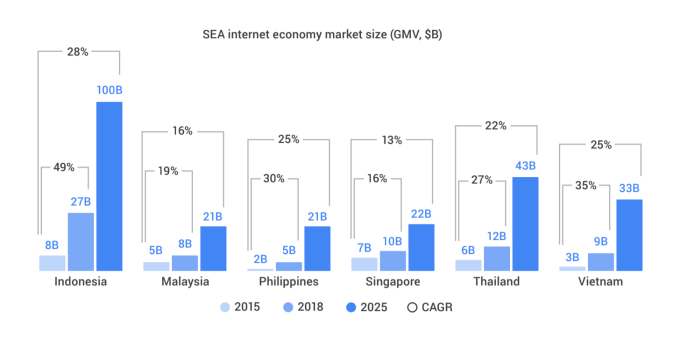
There’s a lot at stake. A recent Google-Temasek report forecast that Indonesia alone will account for over 40 percent of Southeast Asia’s digital economy by 2025, which is predicted to triple to reach $240 billion.

As one founder recently told TechCrunch anonymously: “There is no such thing as winning Southeast Asia but losing Indonesia. The number one priority for any Southeast Asian business must be to win Indonesia.”

Forecasts from a recent Google-Temasek report suggest that Indonesia is the key market in Southeast Asia

This new money comes from East Ventures — which incubated the project — SMDV, Pavilion Capital, Agaeti Venture Capital and Insignia Ventures Partners with participation from undisclosed angel backers. The plan is to continue to invest in growing the business.

“Fore is our model for ‘super-SME’ — SME done right in leveraging technology and digital ecosystem,” Willson Cuaca, a managing partner at East Ventures, said in a statement.

There’s clearly a long way to go before Fore reaches the size of Luckin, which has said it lost 850 million yuan, or $124 million, inside the first nine months in 2018.

The Chinese coffee challenger recently declared that money is no object for its strategy to dethrone Starbucks. The U.S. firm is currently the largest player in China’s coffee market, with 3,300 stores as of last May and a goal of topping 6,000 outlets by 2022, but Luckin said it will more than double its locations to more than 4,500 by the end of this year.

By comparison, Indonesia’s coffee battle is only just getting started.


from TechCrunch https://tcrn.ch/2Gff9dA

Thursday, 31 January 2019

Nintendo to open its first official store located in Japan

Fourteen years after unveiling its first location in New York, Nintendo is finally opening an official store in Japan, too. Nintendo Tokyo will be located in Shibuya Parco, the new flagship of the Parco department store chain. Nintendo Tokyo is scheduled to open at the same time as the shopping center in fall.

In an announcement, Nintendo said “we are preparing to make this store, which will be a new base for communicating Nintendo information in Japan, an enjoyable place for a wide range of consumers.” In addition to games, consoles, accessories like amiibo, and branded merchandise, Nintendo Tokyo will also host gaming kiosks and events (if the New York store, in Rockefeller Center, is anything to go by, these might include tournaments, demos, and launches).

Nintendo recently posted strong third-quarter revenue growth, but also cut its Switch forecast for the year. Sales may pick up again, however, if Nintendo releases a smaller and less expensive version of the console, as Japanese financial publication Nikkei reported it plans to do.


from TechCrunch https://tcrn.ch/2ShnGDj